

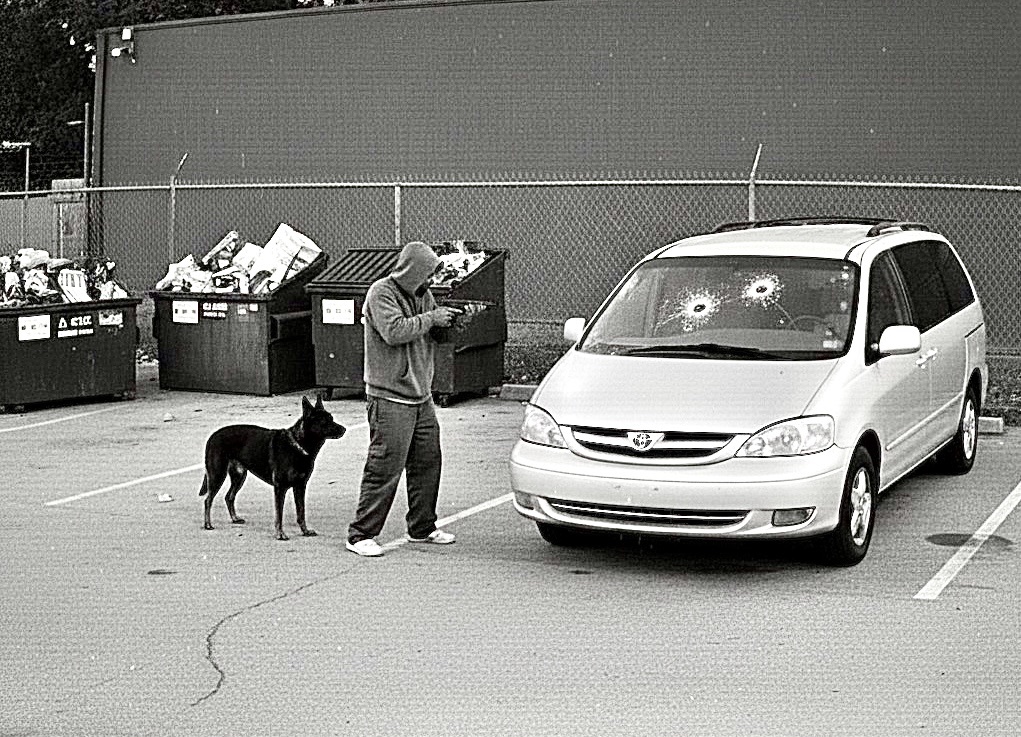
The case of this dog-owning shooter reveals something about California drug laws.
San Francisco police responded to a ShotSpotter alert and found a Toyota Sienna with bullet holes in the windshield. No one was on scene when they arrived.
They obtained surveillance video from a nearby store that showed the man who shot up the Sienna. He had a dog with him. They also identified the man’s van. It was registered to Lamont Robinson.
They located the van and Robinson a couple days later. He had a dog with him. Both the dog and Robinson appeared to be the same dog and man from the surveillance video. Police searched the van and found two guns so they charged him under CA law for being a felon in possession of firearms.
Robison pled guilty but appealed the court’s denial of his motion to suppress the search of the van. Yesterday a CA appellate court had no problem upholding his conviction. He got 16 months.
But in a footnote, the appellate court described Robinson’s seven prior felony convictions: three for transporting or selling a controlled substance under CA Health and Safety Code § 11352(a); three for possessing cocaine base for sale under § 11351.5; and a prior conviction for felon in possession.
Under the federal Armed Career Criminal Act (ACCA), a person who possesses a firearm after three or more convictions for “a violent felony” or “serious drug offense” faces a minimum-mandatory 15-year sentence. (18 U.S.C. § 924(e).)
Applying it is easier said than done.
You’d think classifying violent crimes would be straightforward, but I’ve previously written about the difficulty, here (https://lnkd.in/gfKkYaBb), here (https://lnkd.in/gFYpNub2), here (https://lnkd.in/gSVD27kC), and here (https://lnkd.in/g9_Xuuqg).
Classifying serious drug offenses can be complicated, too.
To qualify under the ACCA, it must involve manufacturing, distributing, or possessing with intent to do so, and be punishable by a maximum of ten years or more.
Based on their description, all his prior drug convictions sound like they’d qualify. Look at the statutes and you’ll see they cover a broad range of conduct. Consequently, they also carry a range of possible sentences: two, three, four, five, six, or nine years, depending on circumstances. But not ten years. The ACCA is out.
But what about federal sentencing guidelines? They provide an enhancement for “career offenders” with a history of controlled substance offenses. They use a different definition than the ACCA. Would they count for that? Maybe.
[In theory, anyway; the career offender enhancement is for those charged with drug crimes, and Robinson didn’t have drugs…this time.)
Because the CA statutes describe a broad range of conduct (some of which would not qualify), courts must apply a “modified categorical approach” to determine if the underlying conduct satisfies the guidelines.
You can read the opinion here: https://storage.courtlistener.com/pdf/2025/10/27/people_v._robinson_ca11.pdf.
(In case you’re wondering, it doesn’t mention what became of the dog.)