

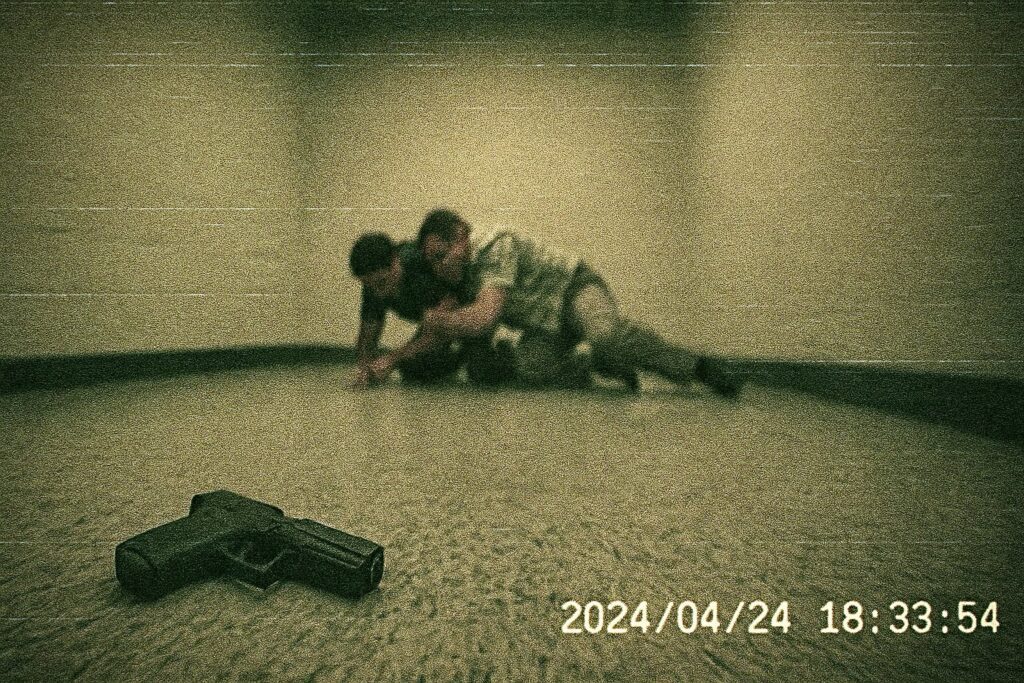
Police tackle two people and a gun falls to the floor. One is a felon, one isn’t. Whose is it?
That’s the question the government faced in this case from DC, and it was willing to be intrusive to answer it. But this magistrate is no “rubber stamp.“
Because the order is redacted, the facts are murky. Two people were wrestling when police tackled them, and a gun fell out.
My guess is it was a felon and his wife in a domestic dispute, and when the gun fell to the floor, the wife claimed it was hers because she isn’t prohibited. Sure they may scuffle sometimes, but she didn’t want him to go to jail.
Wives and girlfriends often come to the defense of their significant others when they get caught with guns they shouldn’t have, and the government must overcome those claims (assuming they are untrue). Often an investigator can disprove a claim of ownership through questioning, eliciting answers to show the claim is implausible.
In this case though, the gun was actually registered to the wife and she had a license to carry it. (Again, I’m speculating it was a wife to fill in blanks.)
So the government took a different tack to try to prove that it was the felon—not her—who actually had and dropped the gun.
The felon was arrested and charged in federal court and the government sought a subsequent search warrant for DNA from both people in the scuffle. They also wanted to search a phone.
The problem is the wife is not prohibited from possessing firearms, so why would the government want her DNA? To prove she’s lying and show that her DNA was NOT on the firearm. They wanted to exclude her. The government even called the purpose of the warrant an “exclusionary search.”
But, as the magistrate notes: “that is not a thing.”
The magistrate’s order reminds that to obtain a search warrant the government must demonstrate there is probable cause to believe a crime occurred. But here, her possession of the gun is not a crime, so it fails. And since it is otherwise only speculative that the felon had the gun (and there is evidence to the contrary, i.e., the wife’s claim), the magistrate denied the search warrant in total. It was the first time in 1,000+ warrants the magistrate had been presented.
The order explains why magistrates must not be a “rubber stamp,” and why even a grand jury indictment of the felon does not supply the probable cause for a search. (That would be substituting the grand jury‘s judgment for the magistrate’s).
There is also discussion of the government’s attempt to search the phone. The magistrate finds its basis speculative and overreaching. Essentially: everyone takes pictures of themselves so there might be pics of the felon with the gun on there. But by that logic, every suspect’s phone would automatically be searchable when a crime is discovered.
The magistrate also rants a bit about the affiant’s boilerplate “training and experience” statement, but it’s a little overblown. Still, it’s a good reminder that, as the Constitution says, warrants must be particular.
This order also taught me a new word: propinquity. It was from a SCOTUS quote and means “proximity” (as in a person’s mere proximity to crime does not supply PC).
I saw this case in a post on the Volokh Conspiracy, here: https://lnkd.in/g7zREfP7.
You can read the order here: https://lnkd.in/gdjxXHHB.