

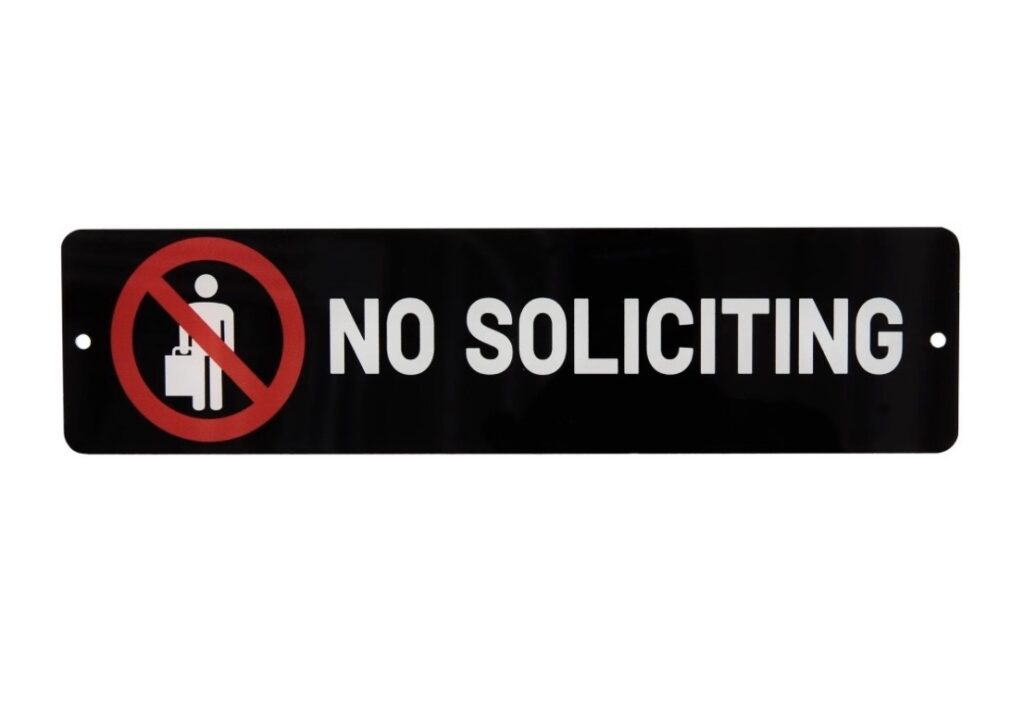
Perhaps the best two dollars I ever spent at Walmart was on a “No Soliciting“ sign. (And I’ve spent a lot of money at Walmart!)
I just don’t like strangers knocking on my door. The sign worked like magic. They’d walk down my driveway and just as they reached the front porch, they’d see the sign…and just turn and walk away.
Every once in a while someone ignored it. I gave those people hell. “Oh, you must be collecting money to fight illiteracy. Because obviously you can’t read my sign.” (Now I live far back in the woods and, for other reasons, strangers don’t come to my door.)
Yesterday, I took a roadtrip to meet a friend for lunch, and as I drove I listened to a recording of oral arguments at SCOTUS this week in the case of Wolford v. Lopez. It reminded me of that sign.
(BTW, listening in the car was way better than listening on a treadmill!)
Wolford involves a recent Hawaii law that makes it a crime to carry a firearm onto open private property (e.g., stores, restaurants, and the like) without express permission from the owner. A store could post a “guns welcome” sign if it wanted to, but absent that or some other affirmative indication the owner consents to people carrying firearms onto the property, even a licensed, peaceful, law-abiding adult commits a crime if they enter the property armed.
Some have called this a “Vampire Law,” a creative reference to Dracula and other lore that vampires can only enter property if invited.
During oral arguments, everyone agreed a private property owner has the right to prohibit guns on their property—if they want to. The ‘right to exclude’ is one of the classic “sticks in the bundle.”
But can the government invoke that right on behalf of every single property owner? Traditionally, there has been an implied right of consent to enter open property. You don’t have to be expressly invited to eat at Chili’s. Hawaii’s rule turns that on its head…but only for guns.
Reasoning by analogy is important in law and Chief Justice Roberts posed an analogy that I think made it clear how this case will turn out.
He asked Hawaii’s lawyer if, considering the First Amendment rather than the Second, whether it would be constitutional for the government to prohibit speech on all open private property unless invited. Could the government criminalize door-to-door campaigning unless a property owner posted a “political speech welcome” sign? There wasn’t a great answer.
Some justices suggested this case might turn on property law alone and not implicate the Second Amendment. I don’t think that’s how this goes.
Interestingly, on the same day, the United States Court of Appeals for the Fourth Circuit found a similar law in Maryland unconstitutional. (You can read that opinion here.)
My prediction is Hawaii loses, 6-3 (maybe even 7-2) and gun rights win. You can listen to the oral arguments here.