

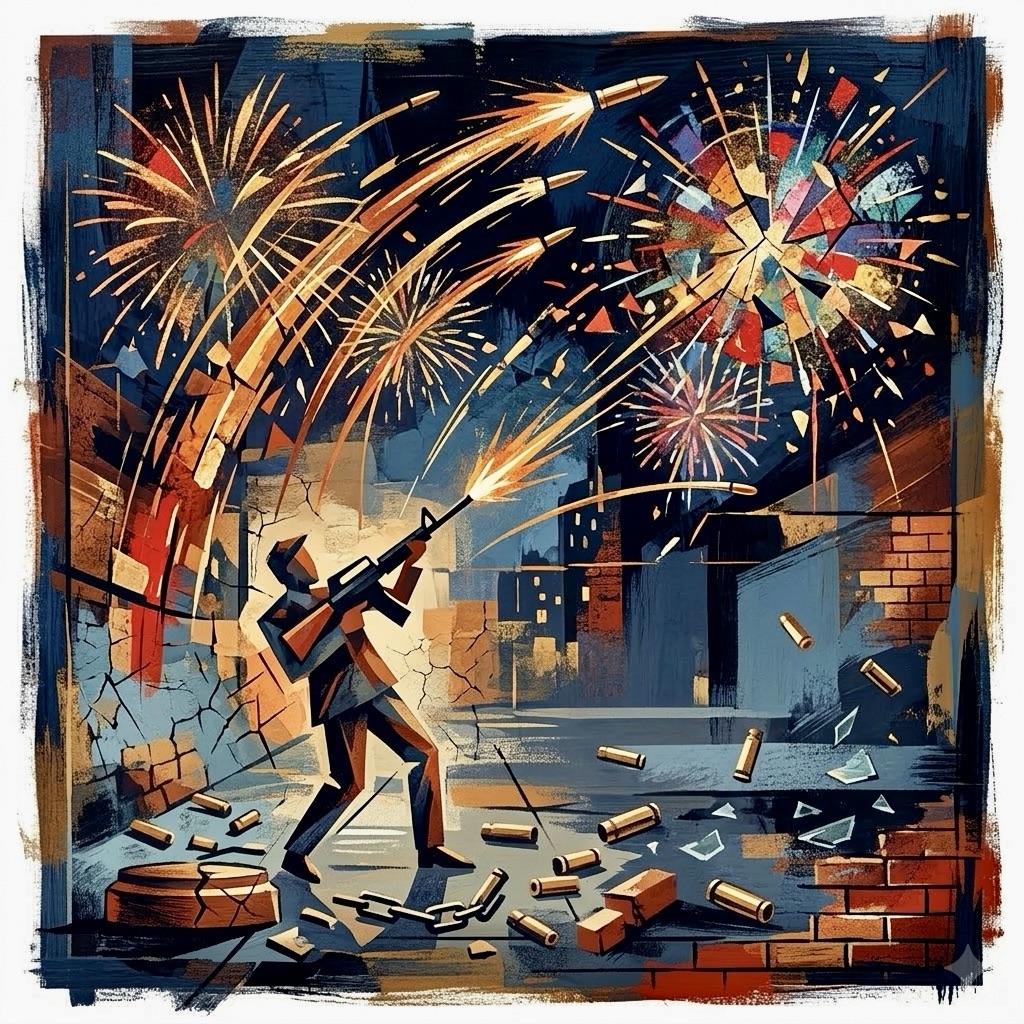
I’ve written before about the dangers of celebratory gunfire but as this court notes, “this dangerous practice can have tragic results in other ways.”
On New Year’s Eve in 2021 (soon to be 2022), James Williams was celebrating in his back yard by firing his Ruger AR-556 (with 50-round drum mag) into the air. His relatives were there, also firing their various guns into the air. His wife was recording the artillery celebration on her phone. The kids were there, watching it all. It was a family affair.
The Williams’s backyard is surrounded by a wooden privacy fence that may keep looky-loos from peeping the backyard barbecues but doesn’t stop the sound of gunfire. That amount of gunfire was sure to attract attention.
It happened that the attention attracted was from a Canton, OH police officer on patrol. It was sustained enough, what with Williams and his kin taking turns firing, then reloading and firing some more, that the officer was able to locate the jubilance. He crept up to the fence and peered through.
What happened next is in dispute, and that’s how it came before the United States Court of Appeals for the Sixth Circuit.
As Williams fired the last volley of his life, the officer fired too (not in celebration). He shot eight rounds through the fence and struck Williams six times.
Williams and his wife ran back inside, not knowing where the gunfire that struck him came from. She called 911 as he collapsed on the floor. Sadly, he died.
Williams’s wife sued the officer under 42 U.S.C. § 1983, for deprivation of rights under color of law. She alleged he violated Williams’s right under the Fourth Amendment to the Constitution to be free from excessive force.
The officer moved for summary judgment based on qualified immunity. The trial court denied it, finding there was a genuine dispute about whether Williams was still firing into the air (which is dangerous but doesn’t justify deadly force) when the officer shot him, or whether as the officer claimed, he saw the gun turn toward him.
Last week, the Sixth Circuit affirmed the lower court. Civil litigation involving use-of-force and qualified immunity can be complex. The court highlighted that complexity in its opinion.
Interestingly, one fact in dispute was whether celebratory gunfire on NYE was common. The court mentioned some of the same history I wrote about in “What Goes Up … : A Brief Legal History of Celebratory Gunfire.” It agreed a reasonable jury could find it was common.
It also held that a reasonable jury could find Williams was still firing into the air when he was shot, as surveillance video from the house suggested. However, neither that video nor the officer’s BWC could truly reveal what the officer perceived, and he believed his life was in danger.
Because there was a genuine dispute about a material fact, no summary judgment or qualified immunity for the officer. To trial this goes.
You can read the opinion here.