

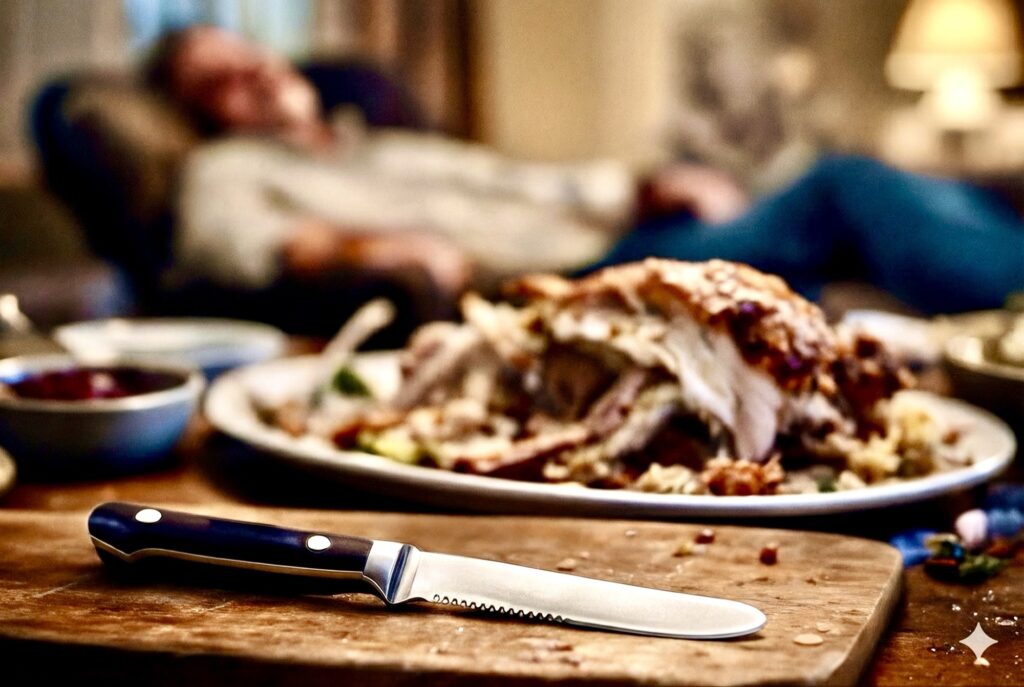
I ate SO MUCH turkey on Thanksgiving! Did I use a weapon to do it?
That’s (sorta) the question the Oregon Supreme Court addressed in an opinion this week.
Anthony Richard Cortes is homeless. (Or “houseless” or “unhoused” if you’re the Oregon Supreme Court.) He was also on probation so he had to meet with his probation officer.
Having no place to call his own, Cortes carried all of his belongings in a backpack. Those belongings included a steak knife with a rounded tip. The probation officer saw the handle of the knife sticking out of the backpack and arrested him for violating the term of his probation that prohibited possessing a “weapon.”
Probation had an expansive view of the word weapon that included “all knives.” The officer testified that he considered “anything” that could be used to harm him a weapon. The Oregon statute, however, is not so explicit and doesn’t define weapon.
Cortes argued it was simply a utensil for eating; its primary purpose being utility, not combat or defense.
The trial court sided with the probation officer. So did the appellate court. The knife was a weapon.
But a divided Oregon Supreme Court saw it differently. The majority opinion (which opened with a quote from Shakespeare) found that analyzing the dictionary meaning of weapon did not resolve the ambiguity between knife-as-tool and knife-for-combat.
So it turned to context. (I’ve written before about the importance of context to legal analysis, e.g., here: https://lnkd.in/gdB9k47h.)
It began by looking at the history of the probation supervision statute (which, ironically, was amended several times to reduce ambiguity in enforcement). It also looked at adjacent terms in the statute, which similarly prohibited possessing “firearms or dangerous animals.”
It then proceeded to run down rabbit holes about wild animals, the word “possess,” other statutes, prior caselaw, and legislative history to conclude that the term weapon has long been ambiguous…and still is.
It decided reading it too broadly would create absurdity, where baseball bats and boiling water could be weapons. That would deprive probationers of certainty and give probation officers too much discretion.
To avoid unconstitutional vagueness in the law, it ultimately adopted a design-based analysis, not a use-based one. Since this knife was designed for cutting steak not harming people: no probation violation.
(But it noted it would still be a crime to actually use the steak knife to harm or threaten a person.)
In a dissent, one judge saw things much simpler based on circumstances. The knife was carried with its handle immediately accessible so it could be pulled from the backpack without opening it or taking it off. It wasn’t with a spoon or fork or wrapped in a napkin. The handle was wrapped in tape to improve its grip. This suggests Cortes was carrying it as a weapon.
Either way, in my hands it would pose a serious threat to turkey!
You can read the opinion here.