

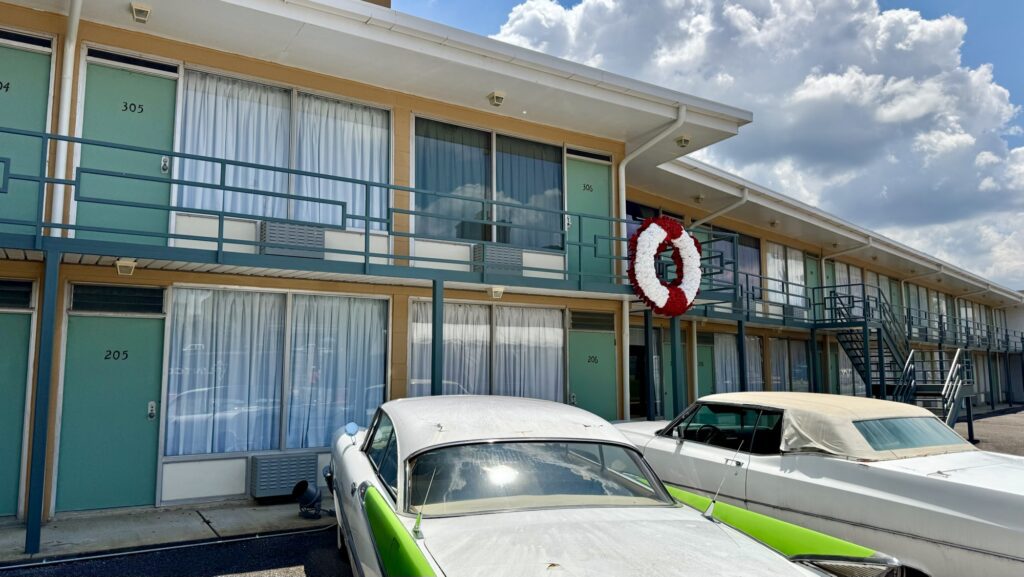
The Lorraine Motel looks much the same today as it did on April 4, 1968. I took this picture of it last week.
It’s frozen in time because it has been preserved as a memorial and expanded into a museum to civil rights. It was there on the balcony, of course, that Dr. Martin Luther King Jr. was shot and killed by an escaped convict. James Earl Ray was on the lam from a Missouri prison when he used an alias to purchase the scoped rifle used to kill Dr. King from a sporting goods store in Alabama.
Dr. King’s death was a national tragedy. It was also one of the precipitating events that led to passage of the Gun Control Act of 1968. That law sought to prevent deceptive purchase like Ray’s, and those of JFK assassin Lee Harvey Oswald, who also used an alias to purchase his murder weapons (https://lnkd.in/gNRa3U_T), by requiring purchasers to appear in person, present government-issued identification, and declare on paperwork that they are not in one of the categories of persons prohibited from possessing firearms when buying a gun from a licensed gun store.
Decades later, the Brady Act would impose a background check to verify the declarations that would-be purchasers make on the paperwork.
I was in Memphis last week to deliver a presentation on firearms at the National District Attorneys Association’s forensics conference (https://lnkd.in/g-YmGD4T) and I walked the few blocks to see this historic site.
During my presentation, I talked about how investigators and prosecutors might use the laws in the Gun Control Act and some of the information collected under it to hold violent offenders and firearm traffickers accountable.
Coincidentally, last week the Bureau of Justice Statistics also released a report analyzing 2021 data from the background check system. (Yes, the government runs that far behind.)
There is nothing earth-shattering in the report but it does reveal that even as the volume of gun sales has grown considerably since the background check system was implemented more than a quarter century ago, the overall percentage of denials has remained relatively steady. Around 1.5% of attempted purchases are denied every year.
Felony convictions account for the largest portion of denials but in 2021, 4.2% of the denials were of fugitives (including people with outstanding arrest warrants).
The significance of the history behind that statistic was not lost on me.
You can read the report here: https://lnkd.in/g-2Vzk3q.