

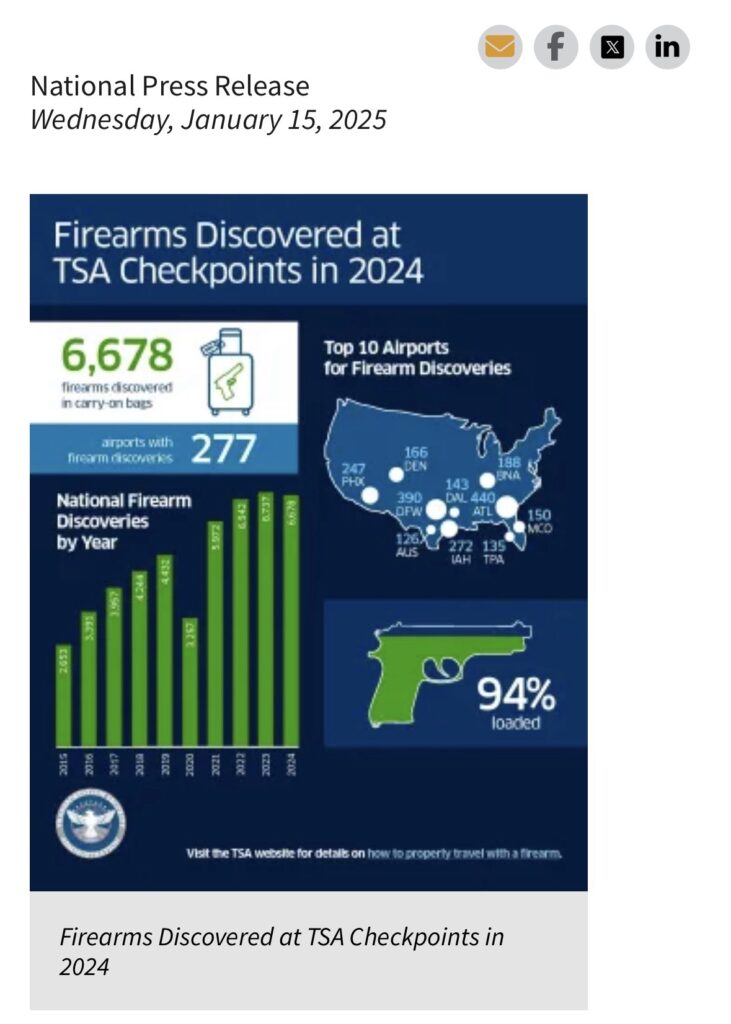
I fly a lot. One of the things I miss most about being a federal agent is flying armed. While it had its inconveniences, and came with serious responsibilities, carrying a gun under Uncle Sam’s authority was pretty cool.
You don’t have to be a Fed, however, to fly with a gun. No, you can’t actually have it on you in flight. And you certainly can’t take it through the security checkpoint (as these people learned the hard way). But there is a simple way any lawful gun owner can travel by air and take their gun with them.
Simply check it, unloaded, in a locked, hard-sided case, and declare it at the counter. Failing to declare it is a crime (18 U.S.C. § 922(e)).
(It must also be lawful to have at both ends of your trip. Beware: state laws on carrying firearms can vary widely. One more reason carrying as a Fed was nice.)
So what happens to the people who tried to carry these 6,678 guns through airport security in 2024?
Most probably only received a hefty fine. TSA will not arrest you and they won’t seize the gun.
That is not to say that you can’t be arrested for it. TSA will typically alert local police, and if state law permits, the police might arrest you.
While there is a federal statute that makes it a crime to try to board a plane armed – 49 U.S.C. § 46505 – it is rarely used.
(Interestingly, this statute includes a different – and terribly wonky – legal definition of “firearm” than is used in Titles 18 and 26. It reads like it was written by someone who didn’t really know guns or gun law.)
Why are there so few prosecutions for what many assume gets you summarily thrown in prison? Because most people whose guns were intercepted were not terrorists or criminals with sinister motives, but rather careless and forgetful gun owners. (Still, careless and forgetful gun owners pose a different sort of public safety risk.)
The better question to ask is how many guns got through? We don’t know for sure, but it certainly isn’t zero.
DHS doesn’t publish audits of TSA screening performance but does report that there are ‘vulnerabilities.’ In 2017, screeners missed”most” firearms smuggled through in covert tests (estimated around 80%). That’s better than the 95% missed in tests two years earlier.
We also know from occasional anecdotal media accounts that guns get through. That’s because even the best weapons screening procedures aren’t foolproof.
Most misses are of guns left in bags that are overlooked by human error; the x-ray ‘sees’ the gun but the screener does not. I doubt many are carried through the metal detectors without being detected. (Then again, it’s much harder to forget you have a gun on your person than one in a bag.)
There are also many false positives at airports. I know this because even though I haven’t carried a gun onboard a plane since I retired, I still occasionally get sent to secondary search.
Who knows how many unarmed people are subjected to this additional screening. It’s just the cost of flying as a civilian, I suppose.